
GEG 2024/2026 for prefabricated houses: what is mandatory
The German Building Energy Act defines the energy standard, renewable-heating share and permitted systems for new prefabricated houses. We explain efficiency levels, the 65% rule and KfW implications.
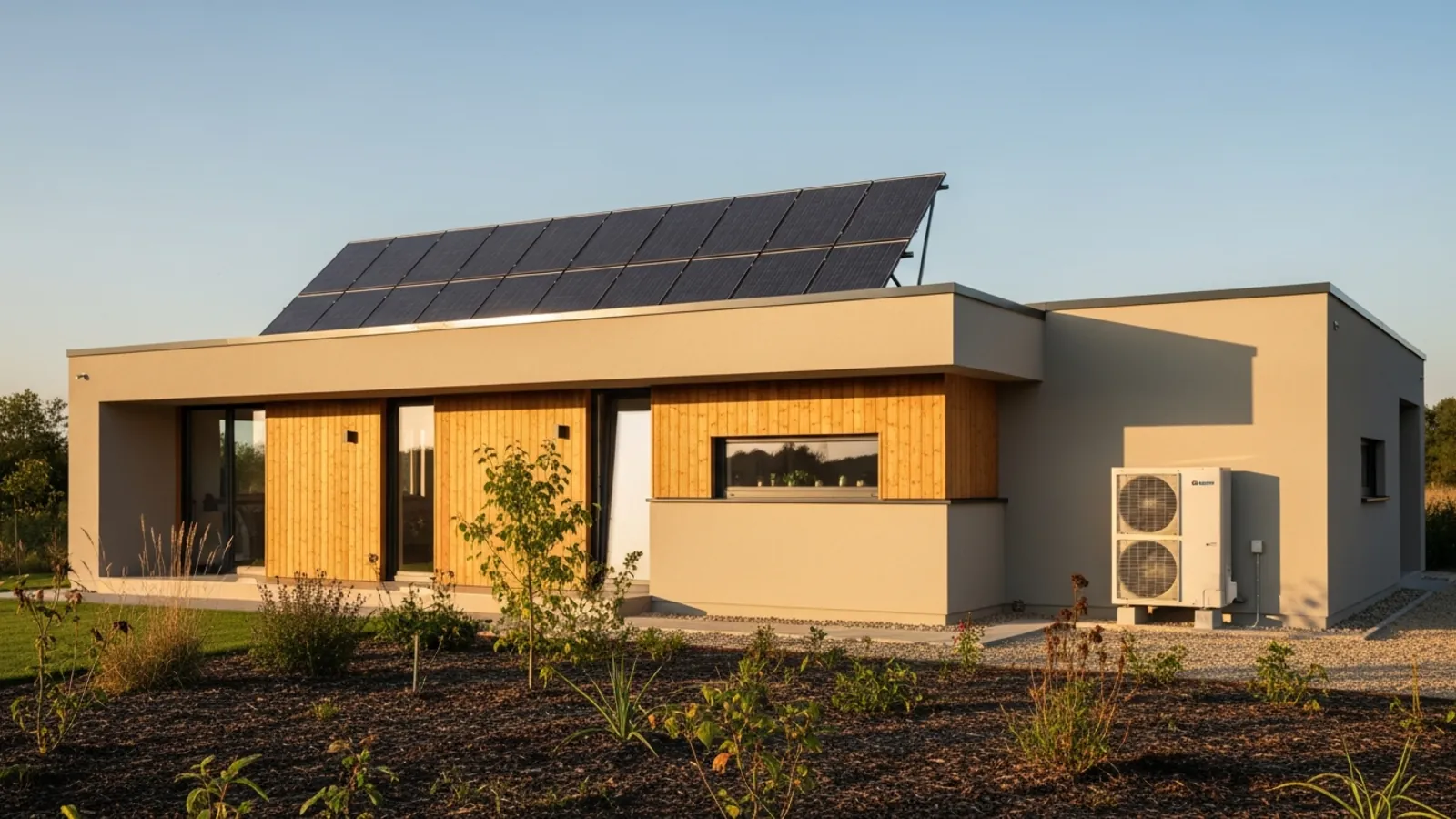
This Building Energy Act (GEG) will be the central legal basis for every new house in Germany in 2026. It regulates bindingly which energy standard a prefabricated house must achieve, how the mandatory share of renewable energies is to be implemented and which heating remains permitted. This guide explains the efficiency house levels, the 65 percent renewable energy rule and the consequences for building applications, building contracts and KfW funding - all as of May 2026.
What is the GEG and who does it affect in 2026?
In brief: Since 2020, the Building Energy Act (GEG) has combined the previous individual regulations from EnEV, EnEG and EEWärmeG. In 2026, it will affect every new building, every comprehensive renovation and every heating replacement. Exactly the same requirements apply to prefabricated houses as to solid houses: primary energy requirement, heat transfer coefficient, heating renewable energy share and obligation to submit an energy certificate. The federal government has a duty to 65 percent renewable energy anchored as a central lever for every newly installed heater. The central reference value is the so-called reference building - a virtual standard against which your building is measured. Anyone who plans in accordance with the GEG benefits directly from the federal program Climate-friendly new building of the BMWSB.
The wording of the GEG is sober in the Federal Law Gazette, but in practice its implementation is complex: In 2026, every building application must contain an energy certificate in accordance with the GEG as well as proof of the renewable energy requirement. An energy efficiency expert from the BAFA list creates these documents - for brand providers from our detailed comparison, this is included in the house price. The building supervisory authority will not issue a permit without a GEG-compliant calculation. More about the procedure in Building permit guide .
Efficiency house levels 2026: EH 55, EH 40, EH 40 NH and QNG in comparison
In brief: Efficiency house levels express how much energy a building consumes compared to the legal reference building. EH 55 means 55 percent of the reference requirement (i.e. 45 percent less). EH 40 means 40 percent (60 percent less), EH 40 NH also means sustainability according to the QNG standard. The minimum standard for KfW funding in 2026 is EH 55, the low-interest KFN 297/298 require EH 40 or QNG.
Efficiency house levels 2026 in direct comparison
| stage | Primary energy requirements | Transmission loss | KfW funding 2026 |
|---|---|---|---|
| EH55 | 55% of reference | 70% of reference | Yes, the KFN level is no longer applicable |
| EH40 | 40% of reference | 55% of reference | KFN 297, up to €100,000 |
| EH 40 NH (with QNG) | 40% + sustainability | 55% of reference | KFN 298, up to €150,000 |
| EH 40 Plus (PV+storage) | 40% + own consumption | 55% of reference | Discontinued model, regional |
In the market of 35 brand providers, EH 55 2026 is standard in 95 percent of the houses and included in the house price. EH 40 as a surcharge option costs an additional 8,000 to 25,000 euros. EH 40 NH (Sustainable Building Quality Seal) requires additional evidence of life cycle, freedom from pollutants and recyclability - surcharge of 12,000 to 35,000 euros, but higher KfW subsidy. Details in KfW funding guide 2026 .
The 65 percent rule: Which heating is still allowed in 2026?
In brief: Since January 2024, all newly installed heating systems in new buildings must be powered by at least 65 percent renewable energy. The following are permitted in 2026: heat pump (air, brine, water), hybrid heating with heat pump + peak load gas, direct electricity heating in efficiency houses, solar thermal energy + wood/pellet heating, connection to district heating network with ≥ 65 percent renewable energy share. Pure gas or oil heating is practically impossible in new buildings.
- Air-water heat pump (standard in prefabricated houses 2026, COP 3.0-4.5).
- Brine-water heat pump with geothermal collector / geothermal probe (higher efficiency, investment €18,000–32,000).
- Hybrid heat pump with peak load gas (declining as gas becomes more expensive in the medium term).
- Pellet heating + solar thermal energy (for wooden house lovers, maintenance higher than with heat pump).
- District heating from renewable sources (often the best solution in large cities, check compulsory connection in B-Plan regulations).
- Hydrogen-ready heating (theoretically permissible, practical suitability can still be improved in 2026).
Heat pump details on COP values, buffer storage and JAZ can be found in Heat pump guide. Ours deals with photovoltaics in combination with a heat pump PV Guide.
U-values 2026: What GEG Annex 1 requires
In brief: GEG Annex 1 contains the heat transfer coefficients (U-values) of the reference building. For a classic single-family house in 2026, the following applies as a reference: external wall ≤ 0.28 W/(m² K), roof ≤ 0.20 W/(m² K), floor slab to the ground ≤ 0.35 W/(m² K), window ≤ 1.3 W/(m² K), external door ≤ 1.8 W/(m² K). Brand suppliers will fall significantly below these values in 2026 - external walls will reach 0.15-0.18 W/(m² K), roofs 0.12-0.15 W/(m² K).
U-values 2026 - GEG reference vs. typical brand provider
| Component | GEG reference | Brand provider standard | EH 40 / Premium |
|---|---|---|---|
| external wall | ≤ 0,28 | 0,17 | 0,12–0,15 |
| Roof against outside air | ≤ 0,20 | 0,14 | 0,11–0,13 |
| Base plate to the ground | ≤ 0,35 | 0,22 | 0,16–0,19 |
| window (Uw) | ≤ 1,3 | 1,1 | 0,75–0,90 |
| Exterior door | ≤ 1,8 | 1,4 | 0,90–1,10 |
| Thermal bridge surcharge ΔUWB | 0,05 | 0,03 | 0,01–0,02 |
There are two reasons for the strong over-fulfillment of the brand provider standard: Firstly, timber frame construction is particularly energetically efficient with thin wall thicknesses (typically 30-36 cm) due to the high thickness of the insulation material. Secondly, meeting the EH-55 standard requires better overall envelope components because ventilation losses and system technology can increase primary energy requirements.
GEG-compliant prefabricated house at a fixed price
All 35 brand providers in our comparison will deliver EH-55 level as standard at a fixed price in 2026. EH 40 and QNG are available as an additional charge option - we will show you the exact additional costs.
Controlled living space ventilation (KWL): mandatory or recommended?
In brief: Controlled living space ventilation with heat recovery (KWL-WRG) will not be required by law in any federal state in 2026, but is actually indispensable in EH-40 houses because otherwise ventilation losses would blow up the energy balance. Although the GEG allows window ventilation, the calculated ventilation loss assumes 0.5 1/h air change - a value that cannot be guaranteed over the year without KWL in airtight envelopes. Additional costs in 2026: 7,500–14,000 euros including distribution channels.
A modern KWL achieves heat recovery levels of 85 to 92 percent - the outgoing exhaust air preheats the incoming outside air using the countercurrent principle. In well-insulated houses, this reduces ventilation loss by up to 75 percent. In addition, filters (F7/F9) ensure cleaner indoor air and protect allergy sufferers. Disadvantages: Maintenance effort (filter change twice a year), power consumption of the fans (40-80 W continuous load), noise perception in poorly designed systems.
GEG in the building application: What evidence will be mandatory in 2026?
In brief: Three GEG proofs are mandatory in the 2026 building application: 1. Energy requirement certificate according to GEG with primary energy, final energy and transmission heat loss of the specific project, 2. Proof of the mandatory renewable energy share with a detail sheet for heating, 3. Summer thermal insulation proof according to DIN 4108-2. For KfW funding, additional documents are required (KfW application form, building financing confirmation from the house bank, QNG proof if necessary).
- Energy requirement certificate according to GEG (calculation by energy efficiency expert BAFA list).
- Detailed calculation of the renewable energy share of heating (heat pump, solar thermal energy, wood, district heating).
- Summer heat protection proof according to DIN 4108-2 (excess temperature degree hours).
- Hydraulic balancing of the heating documented.
- Ventilation concept (including window ventilation, proof that there is no risk of mold).
- For KfW applications: trade-by-trade evidence of component U-values, system technology, renewable heat.
Avoidable errors in the energy certificate
The energy certificate may only be created by certified energy efficiency experts (BAFA list). Common mistake: Providers create the ID card internally and do not enter it into the official list. This will be noticed at the latest when applying for the KfW and can completely jeopardize the building application and the funding. Before signing the contract, obtain written proof of the BAFA list entry of the responsible expert.
GEG in existing buildings: When does it apply to renovations and heating replacements?
In brief: In the existing situation, the GEG 2026 applies in three cases: 1. Heating replacement - 65 percent renewable energy requirement for new systems from 2026 in new development areas, from 2028 in large cities with ≥ 100,000 inhabitants, from 2028 in smaller communities; Transition period until mid-2029. 2. comprehensive renovation of the shell (≥ 10% component area) - component U-values from Appendix 7 GEG must be adhered to. 3. Extension – for extensions ≥ 50 m², the GEG applies in full to the extension.
Anyone who modernizes an existing prefabricated house from the 70s to 90s must therefore carefully check which components are being renovated and which GEG requirements are triggered. Detailed renovation packages and funding Modernization guide . For 2026 renovation obligations, see also BEG (Federal Funding for Efficient Buildings), which provides the funding backdrop parallel to the GEG.
Outlook: How will the GEG become more stringent by 2030?
In brief: By 2030, the GEG is expected to be tightened in two ways: 1. Raising the minimum standard for new buildings from EH 55 to EH 40 (planned for 2027/2028, EU directive EPBD requires “zero-emission buildings” for new buildings from 2030). 2. Expansion of the renewable energy requirement in existing buildings across the board from mid-2029. Anyone who builds a KfW 40 house in 2026 is already future-proof; Anyone who relies on EH 55 will benefit from shorter construction times and lower costs - but will have to retrofit in the event of a later expansion.
Market observation 2026: For brand providers, the standard mode is increasingly shifting towards EH 40 as the default, EH 55 is becoming a savings model. Premium providers such as Baufritz, Schwoerer and FingerHaus already supply EH 40 NH (QNG) for an additional charge of €12,000-25,000. If you think long-term and use the KFN 298, the EH 40 NH 2026 will often be more economically viable than the EH 55.
GEG compliant and KfW eligible in one step
Three brand providers from our 35 manufacturer comparison provide you with fixed price offers at EH-40 level including KfW application. We bundle your request – you see the additional costs transparently.
Ready for the next step?
Use our network of reviewed providers to receive free quotes matched to your requirements.
Compare quotes nowFrequently asked questions
The most common questions about GEG 2024/2026 for prefabricated houses, answered concisely by the fertig-haus.net editorial team (updated 2026).
