
Solar PV & storage in prefabricated houses 2026: a practical guide
Sizing, economics and funding for solar PV and battery storage: suitable system size, whether storage pays and which providers integrate PV as standard.
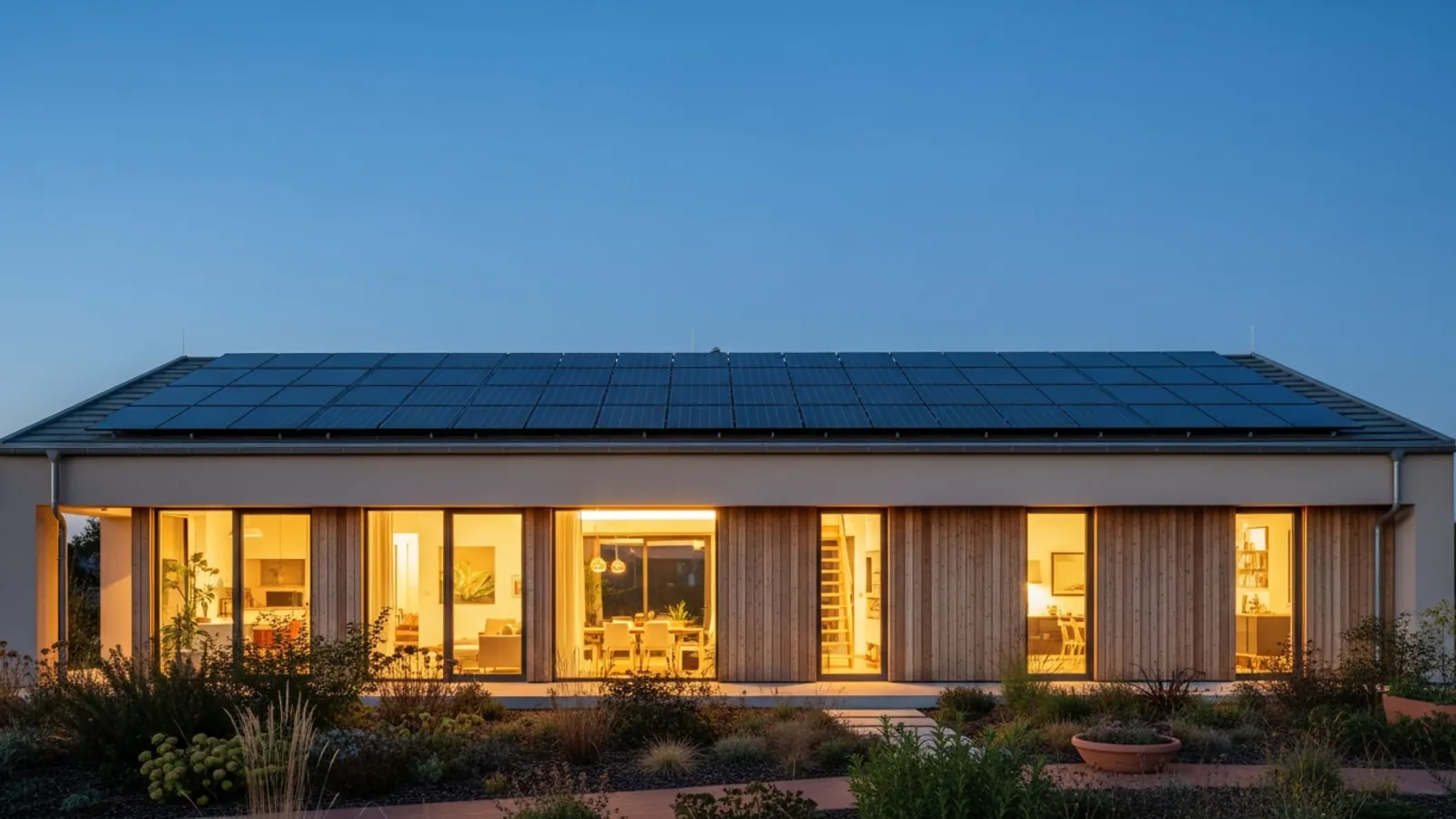
A photovoltaic system should be on the agenda for every prefabricated house in 2026 – partly as a legal obligation (solar requirements in Bavaria, Baden-Württemberg, North Rhine-Westphalia, Berlin), partly for purely economic reasons. This guide explains the correct system design, whether aBattery storage pays off, whichever KfW and BAFA programs are effective and which brand providers PV already have in the roof and energy certificate ex works integrate.
Will photovoltaics in prefabricated houses still be worthwhile in 2026?
In brief: Yes – even more clearly than in 2024. Module prices will be at one in 2026 historical low (€ 110-145 per kWp module ex works), inverters and Storage has also become cheaper. A 10 kWp system with 10 kWh storage costs €18,500-24,500 turnkey and delivers9,000-11,500 kWh per year. At 30 cents/kWh electricity price and 70 percent For self-consumption, the payback is 9 to 13 years. Over 25 years The benefit adds up to 35,000 to 65,000 euros over the operating period.
The economic viability is so good in 2026 because of the module prices have fallen by 60 percent since 2022, while electricity procurement prices have risen 29-34 ct/kWh. In addition, there are the solar obligations in five Federal states – those who have to install anyway optimize at fullDesign the own consumption and thus the return.
Design: How big does my PV system have to be?
In brief: Rule of thumb for 2026: 1 kWp per 10 m² of heated living space Heat pump heating. A 140 m² single-family home typically requires 12 to 14 kWp photovoltaics. Anyone who also wants to charge an electric car (10,000 km/year ≈ 1,800 kWh), add 2 kWp. Anyone who has a pool, oneAir conditioning or a home office with a server rack operates, again 1 to 2 kWp. Larger systems (≥ 15 kWp) switch to EEG direct marketing, which increases administration somewhat, but enables higher returns.
PV design 2026 — recommendations for typical consumption profiles
| Consumption profile | Recommended system size | Storage recommended |
|---|---|---|
| Single-family home 100 m², without heat pump or electric car | 5-7kWp | 5-7 kWh |
| Single-family home 130 m², heat pump, without electric car | 8-10kWp | 8-10 kWh |
| Single-family home 150 m², heat pump + electric car | 10-14kWp | 10-14 kWh |
| Single-family home 180 m², heat pump + 2 electric cars + pool | 14-18kWp | 14-18 kWh |
| DHH/RH 110 m², heat pump | 7-9kWp | 7-9 kWh |
Important for the size of the system: The roof area must be sufficient. Per kWp calculate 4.5 to 5.5 m² module area. So a 12 kWp system occupies about 55 to 65 m² roof. Problems with a gable roof facing south, Things can get tight with hipped or pent roofs.Your provider plans SmartFlat or in-roof system, the occupancy area is halved because the system is integrated - additional costs of 1,200-2,500 euros per kWp.
Battery storage: When is it worthwhile and when is it not?
In brief: Battery storage (lithium iron phosphate, LFP) increases this Own consumption share in 2026 from around 30 percent (excluding storage) to 65-80 percent. With storage prices of €750-1,100 per kWh and one With a service life of 6,000+ cycles, storage pays for itself in 8-12 years.Rule of thumb: 1 kWh of storage per 1 kWp of PV is balanced. More storage The amortization deteriorates because the additional cycles are not full be exploited.
Storage is particularly worthwhile if:
- Heat pump is available (consumption can be shifted to sunny hours).
- Electric car is available (charging during the day).
- High electricity consumption (≥ 4,500 kWh/year without heat pump, ≥ 8,000 kWh/year with HP).
- Electricity price remains stable and high (assumption of 32+ ct/kWh over 10 years).
- Owner stays in the house for the long term (storage amortized from year 9).
Storage is NOT worth it if:
- Electricity consumption less than 3,500 kWh/year and no heat pump or electric car.
- Rental or planned sale in the next 5 years.
- Very cheap electricity tariff (with special public utility tariffs 21-25 ct/kWh).
Which storage is the best choice in 2026? Market leader with high Service quality is sonnenBatterie, BYD, Senec, E3/DC (house power plant) and Fronius with Tesla Powerwall. With premium brand providers our For a detailed comparison, the storage is often included in the PV package.
PV ex works – included in the house price
At least 14 of the 35 brand providers in our detailed comparison deliver PV systems that are already integrated into the roof ex works with storage and KfW application. We will take you to three suitable providers.
Funding 2026: KfW 270, BAFA, EEG remuneration
In brief: The most important funding in 2026 is the KfW loan 270 “Renewables Energies – Standard" with reduced interest rates up to 150,000 euros per project. BAFA only supports photovoltaics in conjunction with Heat pump renovation in existing buildings. EEG feed-in tariff is 2026for new systems up to 10 kWp 8.20 ct/kWh, from 10 to 40 kWp 7.10 ct/kWh, Guaranteed for 20 years. From 2026, the 70 percent feed-in requirement will no longer apply Limitation for small systems.
PV funding 2026 at a glance
| Program | Who? | What? | Amount |
|---|---|---|---|
| KfW 270 | Private / commercial | Low-interest loan | up to €150,000 |
| EEG feed-in tariff | Private | 20 year guarantee | 8.20 ct/kWh (up to 10 kWp) |
| BAFA – BEG EM | Existing property with renovation | Subsidy for WP exchange | 30% + bonuses (max. 70%) |
| VAT 0% (UStG § 12 III) | EFH owner | Purchase + installation tax free | Practice: Gross = Net |
| KfW home ownership promotion WEF | New family building | PV co-financed in the house price | up to €270,000 loan |
| State programs (BY, BW, NRW) | Private regional | Grant storage/combinations | 1.000–6.000 € |
The VAT exemption according to Section 12 Paragraph 3 UStG will continue to be active in 2026 – PV systems up to 30 kWp on residential buildings are 0 percent when purchased VAT charged. This saves around 3,500 euros for a 10 kWp system, without you having to claim input tax.Prerequisite: you are private owners and operate the facility as a small business owner. The tax advisor will clarify details about the tax status for systems ≥ 10 kWp.
In-roof vs. on-roof systems: Which variant suits the prefabricated house?
In brief: Rooftop systems are equipped with rail systems over the roof covering assembled (90 percent market share in 2026). In-roof systems replace them Roof tiles completely and integrate visually (10 percent market share, increasing).On-roof is 1,200-2,500 euros per kWp cheaper and easier retrofittable; In-roof is optically of higher quality, denser and in many 2026 development plans are required (“homogeneous roof covering”). In New prefabricated houses are gaining market share because the roof is already there is created by the provider.
| criterion | Rooftop | In-roof |
|---|---|---|
| Investment per kWp | 850–1.200 € | 1.450–1.900 € |
| optics | classically visible | integrated, homogeneous |
| Roof penetrations | many | no |
| Weight (statics) | +25 kg/m² additional | Roof tile weight is eliminated |
| Market share 2026 | 90 % | 10% (increasing) |
| B plan requirement (homogeneous) | often conflict | compliant |
Brand suppliers such as Hanse Haus, Bien-Zenker, Schwabenhaus and FingerHaus will offer in-roof packages as standard in 2026. Provider with prefabricated wooden roof can integrate in-roof particularly cleanly because module frames fit directly into it the counter battens can be inserted.Anyone who builds a flat roof (pent roof, Flat roof) is more likely to choose an on-roof with a ballast-free elevation.
PV + heat pump + electric car: The optimal combination in 2026
In brief: The ideal combination in 2026 is 10-14 kWp PV, 10-14 kWh storage, a 6 to 9 kW heat pump (brine or air) and a smart wallbox (PV surplus-managed charging). The system reached 65-80 percent self-consumption and makes you 70-85 percentenergy self-sufficient in summer, 30-45 percent all year round. Investment total 2026: 38,000–58,000 euros. Payback compared to conventional Solution: 12-16 years.
Intelligent is crucial for economic efficiency Energy management, which controls the power flows between PV, storage, Heat pump, wallbox and network optimized. Manufacturers like sonnen, E3/DC, SMA, Fronius and Senec all supply energy management modulesOrchestrate components. With the brand suppliers of our Detailed comparison is the combination as a “complete energy package” or “Plus energy house” can be ordered at a fixed price.
More about heat pump design in Heat pump guide and for smart energy management in Smart home guide. The connection with the GEG compulsory renewable energy share is clarified GEG guide.
Installation, registration, commissioning: The process in 2026
In brief: The commissioning of a PV system in 2026 takes from the order to Feeding 6 to 12 weeks. Steps: 1. Detailed offer with roof measurement, 2. Registration with the network operator (connection request), 3. Consent Network operator (4-8 weeks), 4.Installation of inverters and modules (1–3 days), 5. Meter replacement by measuring point operator, 6. Commissioning Protocol, 7. Entry in the market master data register (mandatory 30 days).
Market master data register requirement
Every PV system must be installed within 30 days of commissioning The Federal Network Agency's market master data register must be entered. Failure to do so will result in the feed-in tariff no longer being paid – 8.20 cents/kWh times 11,000 kWh = around 900 euros per year loss. Providers like HanseHouse take over the entry in the complete package. If you do it yourself: Online form on marktstammdatenregister.de, processing time 15 minutes.
Maintenance, cleaning, insurance: How much does PV cost to operate?
In brief: PV systems will require little maintenance in 2026. Usual operating costs: Insurance 80-150 €/year (often as an extension of home building insurance), maintenance every 4 years 250-450 €, cleaning optional 200-600 € every 5 years, Inverter replacement after 10-15 years €1,500-2,500, storageIf necessary, replace after 15-20 years. In total, around 1.2 percent of the Investment per year – significantly less than the savings on electricity costs.
The economic life expectancy of a modern PV system is 2026 at 25-30 years with a performance guarantee from the manufacturer (typically 25 years 80 percent performance). Storage (LFP chemistry) reaches 12-18 years Lifespan with 80 percent remaining capacity.The inverter is the Shortest-lived component at 10-15 years – plan this investment for the middle phase of life.
Complete photovoltaics: three fixed-price offers including registration
Brand providers from our detailed comparison provide you with complete packages - modules, inverters, storage, registration with the network operator, entry into the market master data register. You pay a fixed price and use your own solar power from day one.
Prefabricated house photovoltaics – the most important search queries
Solar PV for a prefabricated house
Solar PV works best when roof orientation, storage, the heat pump and self-consumption are integrated early. Assess both economics and technical requirements.
Ready for the next step?
Use our network of reviewed providers to receive free quotes matched to your requirements.
Compare quotes nowFrequently asked questions
The most common questions about Solar PV & storage in prefabricated houses 2026, answered concisely by the fertig-haus.net editorial team (updated 2026).
How large should the PV system be?
Does battery storage pay?
How much electricity can be self-consumed?
Solar PV & storage in prefabricated houses 2026 – key searches
Solar PV for a prefabricated house
Solar PV works best when roof orientation, storage, the heat pump and self-consumption are integrated early. Assess both economics and technical requirements.
