
Modernising a prefabricated house: strategies for 1970–1995 homes
More than 600,000 older prefabricated houses need major renovation. We cover typical weaknesses, three realistic packages, PCP/lindane risks and current KfW and BAFA support.
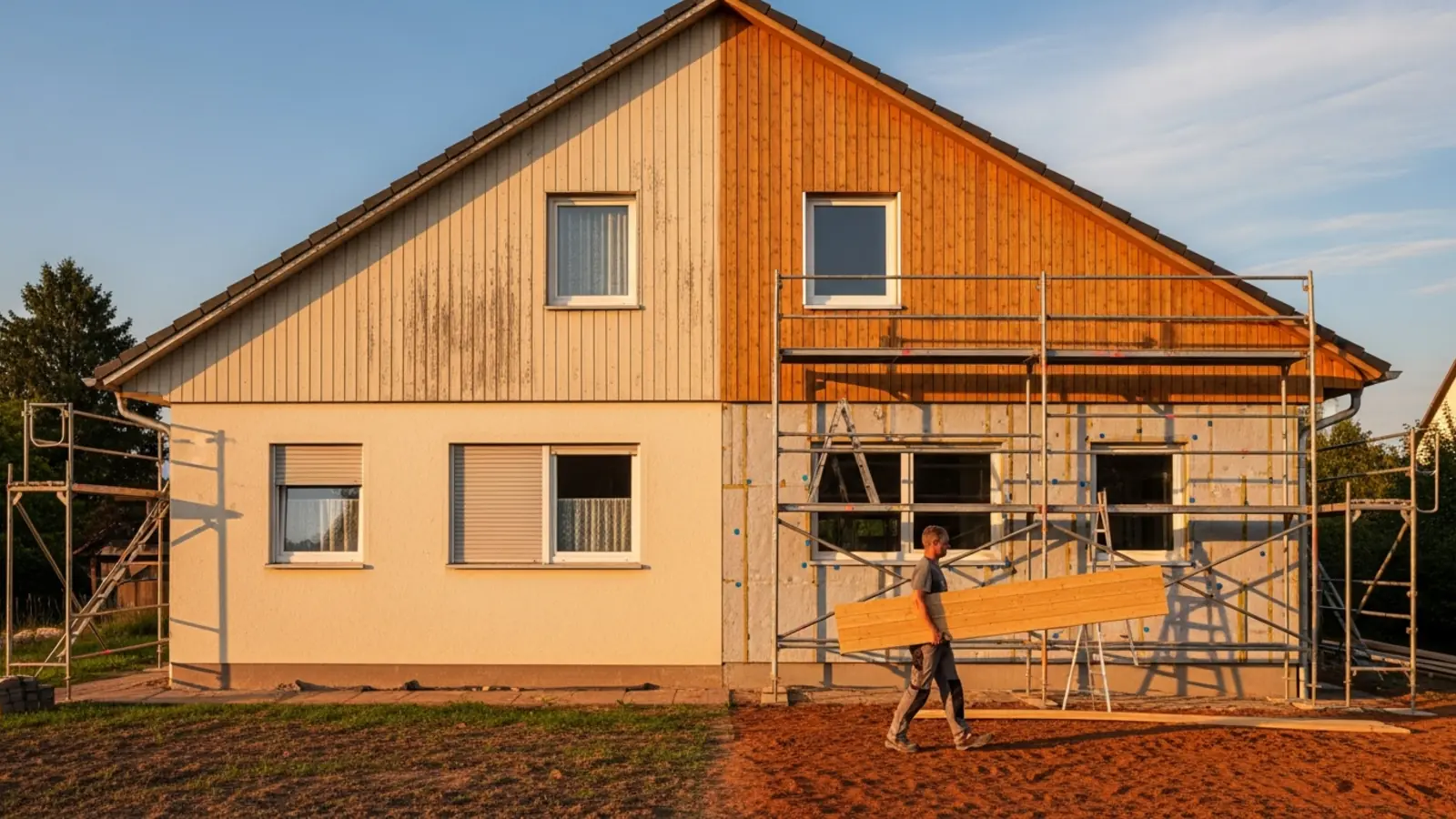
Over 600,000 prefabricated houses from the 1970s and 1980s will be built in 2026 before a general renovation: leaky shell, far below energy efficiency today's standard, partly with wood preservative contamination (pentachlorophenol, Lindane), asbestos Eternit plates or old lead drinking water pipe. This guide shows typical weak points, three realistic ones Renovation packages from 35,000 to 180,000 euros and all current funding programs according to BEG and KfW.
Why will the 2026 renovation wave particularly affect prefabricated houses?
In brief: Prefabricated houses from the boom years 1970-1990 were often built back then approved wood preservatives (PCP, lindane). Built with vapor-permeable foils and minimal insulation thicknesses. Show today Typical damage occurs after 35-50 years: Condensation inWall cross-sections, joint leaks, spongy floor coverings, Enforced roof insulation and outdated heating technology. The substance is With good maintenance, it is stable, the shell and system technology are in need of renovation. needy.
Three factors are driving the need for renovation in 2026: Firstly, increasing legal pressure from GEG and BEG (see GEG guide), secondly, exploding heating and electricity costs in recent years, Thirdly, the ownership structure: Many of these houses are currently being built handed over to the generation of heirs, the renovation cost issues are active put. The range extends from a 35,000 euro energy package toto a general renovation costing 180,000 euros – have to be considered economically Be honest about it.
Typical weak points of old prefabricated houses in detail
In brief: The most common weak points in 2026: 1. Exposure to wood preservatives (PCP/Lindane in interior walls), 2. Asbestos Eternit on facade or roof, 3. Mineral fiber insulation with suspected cancer (KMF class 1 before 1996), 4. uninsulated external wall (U-value 0.5–0.7 W/(m² K)), 5. single-glazedWindows, 6. Asbestos floor tiles or cushion vinyl, 7. outdated Electrical (no FI, old wiring), 8. Lead pipes Drinking water, 9. Oil or gas heating as a constant temperature boiler.
Typical weak points in prefabricated houses 1970–1995
| Component | Common problem | Urgency of renovation |
|---|---|---|
| external wall | U-value 0.5–0.7 W/(m² K), not open to diffusion | high (energetic) |
| Roof / attic | Insulation 80–120 mm, often KMF class 1 | very high (pollutant) |
| Window | Double glazing Ug 2.8 W/(m² K) | high |
| facade | Asbestos Eternit, weathered | very high (pollutant) |
| Interior walls made of wood | PCP/lindane contaminated | Check! |
| floor coverings | Cushion vinyl, asbestos tiles | Check! |
| drinking water | Lead pipes possible (houses before 1973) | very high |
| Electrics | no GFCI protection, ungrounded sockets | high (security) |
| Heating | Low temperature boiler or NT heating oil | very high (GEG) |
| ventilation | Window ventilation, risk of mold after renovation | Concept necessary |
Wood preservatives suspected: PCP and lindane
Building commissions recommended wood preservatives until the mid-1980s (pentachlorophenol, lindane), which are now considered harmful to health. Suspicion arises if yellowish wooden beams are visible in the living area Discoloration, characteristic odor.A wood moisture and Bring a pollutant sample (material sample to the laboratory, 80-250 euros). Clarity. If contamination is proven, the renovation is complex: Sealing with a barrier base, in extreme cases hiking kit.
Taking stock: This is how you start planning the renovation in 2026
In brief: A professional inventory 2026 includes: 1. Energy consultant- Appointment with consumption analysis and energy certificate, 2nd pollutant examination if suspected (KMF, asbestos, PCP, lead), 3. Static assessment visible damage, 4. thermography in winter, 5.airtightness Measurement (blower door). Typically costs 1,800-4,500 euros - this one Investment pays off many times over through tailor-made renovation planning and eligible measures sequence.
- Hire energy advice from a BAFA-listed energy efficiency expert (BEG eligible).
- Have a renovation roadmap drawn up - gives an additional 5% bonus on BEG funding.
- Pollutant testing if suspected: KMF, asbestos, PCP, lindane, lead, mold.
- Thermography to localize thermal bridges and leaks.
- Blower door test (air tightness measurement) to quantify envelope leakage.
- Static assessment of the risk of settlement or cracks, especially on the ground floor.
Three renovation packages: Basic, Comfort, Full Modernization
In brief: For a typical 130 m² prefabricated house from the 1980s, the figure is 2026 Three renovation packages on the market: 1. Basic energy package €35,000–55,000 (replace heating, insulate roof, windows), 2. Comfort renovation 65,000–110,000 € (additional external wall ETICS, ventilation, new bathrooms), 3.Full modernization €130,000-180,000 (shell complete, interior work, new Electrics, Smart Home). BAFA/KfW grant reduces equity capital by 25-60 percent.
Package 1 — Basic Energy €35,000-55,000
- Replacing the heating: air-water or brine-water heat pump (€15,000–28,000).
- Insulate the roof, rafter insulation 200 mm mineral wool (€8,000-14,000).
- Replacing windows with triple glazing Ug 0.7 (€8,000-16,000).
- Hydraulic balancing, buffer storage, domestic hot water module (€1,500–3,000).
- BAFA/KfW application by energy efficiency experts (fee included in the funding amount).
Package 2 — Comfort €65,000-110,000
- All measures from package 1.
- Exterior wall ETICS 18–24 cm EPS or mineral wool (€28,000–48,000).
- Controlled living space ventilation with heat recovery (€8,500–14,000).
- Bathroom renovation 8–12 m² (€12,000–22,000).
- PV system 8 kWp + 8 kWh storage (€14,000–18,000).
Package 3 — Full modernization €130,000-180,000
- All measures from package 2.
- New external doors, safe RC2 (€3,500-5,500).
- Renew drywall/plaster inside (€12,000–22,000).
- Complete floor coverings (vinyl/parquet) (€10,000–18,000).
- Electrics completely new with FI, smart home preparation (€14,000–25,000).
- Replace plumbing / lead pipes (€6,000-12,000).
- Interior fittings: stairs, doors, kitchen electrics (€12,000–25,000).
Renovation with a fixed price and funding from a single source
Several brand providers in our network have specialized renovation programs for prefabricated houses in their portfolio. We will provide you with three suitable providers with a fixed price, BAFA application and construction management.
Funding BEG EM 2026: Combine BAFA grant and KfW loan
In brief: Federal funding for efficient buildings - individual measures (BEG EM) offers 2026 Grants of 30-70 percent for heating, envelope and system technology. Heating replacement is subsidized with basic funding of 30%, plus air conditioning Speed bonus (20%), income bonus (30% atIncome ≤ €40,000) and efficiency bonus (5%). Maximum Funding amount per residential unit: €30,000 (heating) + €60,000 (shell/ system) = up to €90,000 grant possible. KfW 261/262 supplemented with Low-interest loan up to €150,000.
BEG funding 2026 – typical rates for renovation measures
| measure | Basic funding | Bonus possible | Maximum |
|---|---|---|---|
| Air-water heat pump | 30 % | +25% (climate + renewable energy bonus) | 55 % |
| Heat pump brine-water | 30 % | +30 % | 60 % |
| Pellet heating with solar | 30 % | +15 % | 45 % |
| Exterior wall insulation WDVS | 15 % | +10% SFP bonus | 25 % |
| Roof insulation | 15 % | +10% SFP bonus | 25 % |
| Window with U_w ≤ 0.95 | 15 % | +10% SFP bonus | 25 % |
| Ventilation with heat recovery | 15 % | +10% SFP bonus | 25 % |
| Energy advice BAFA | 50 % | — | max. 1,700 € |
Important: The application must be submitted BEFORE the contract is awarded. Who commissioned first and then submits the application, loses the claim. The application for BAFA is made online (www.bafa.de), for KfW via the house bank. The Energy efficiency expert provides confirmation of the application (BzA) and the confirmation after implementation (BnD). More about KfW programs for New construction and renovation in KfW Guide 2026.
Renovation sequence: first shell, then heating – or vice versa?
In brief: The economically correct order for 2026 is: first shell, then Heating. Whoever installs the heat pump first and then insulates it has one Oversized system - more expensive to purchase and inefficient running in operation.If the heating replacement is urgent (old boiler defective, GEG requirement), at least mentally plan the cover and choose the heat pump for the later standard, not the current one.
In practice, the order is often determined by external factors: Funding, material availability, financial resources, personal contribution, Weather. The ideal sequence:
- 1. Energy advice with renovation roadmap (iSFP) - secures a 5% bonus.
- 2. Remediation of harmful substances (KMF, asbestos, PCP) - if necessary, always first.
- 3. Roof and external wall insulation – greatest energy saving effect.
- 4. Replace windows — synchronous with insulation due to connection details.
- 5. Ventilation system - necessary after envelope insulation to prevent mold.
- 6. Replace the heating system - now correctly dimensioned for the insulated existing building.
- 7. Photovoltaics + storage — last, supplemented by heat pump.
- 8. Smart Home + Energy Management — connects all components.
Cost-benefit: When is renovation economically worthwhile?
In brief: Renovation in 2026 is economically worthwhile if the annual Heating cost savings exceed the loan-related annuity – that is This is usually the case with BAFA/KfW-funded measures because 30-70 percent covered by the investment. For full modernization €150,000Gross, of which €60,000 is funding, you finance €90,000 at 3.5% Building interest (annuity €6,300/year). Heating cost savings 1,800-3,500 €/year covers 30-60% of this. Comfort, CO2 balance and livability are the ones non-monetary arguments.
Important: The increase in the value of the property. A modernized one Prefabricated housing from the 80s typically reaches 15-25 percent in 2026 higher market value than a comparable unrenovated property. Who Anyone who wants to stay in the house anyway has the comfort and CO2 advantages Bonus.If you want to sell in 5-10 years, you need to see the value increase offset against the renovation costs - often just positive.
Alternative: demolition and new construction – when is that the better choice?
In brief: Demolition and new construction will be worthwhile in 2026 if the substance is heavy is damaged (fungal infestation in the supporting structure, settlement, severe pollution burden), the renovation costs are 70 percent of the new building costs exceed or the property could be developed significantly better(more living space, better orientation). Demolition costs €25,000-55,000 (including pollutant disposal), then new construction of a KfW 40 house. Funding for new buildings is attractive in 2026 (KFN, WEF), but Real estate transfer tax and development are again not due because that Property remains.
Anyone considering demolition and new construction should consult a building expert the inventory assessment and an energy efficiency expert for the Order the renovation schedule in parallel. The cost-benefit calculation This makes it transparent. More about GEG-compliant new building planning in GEG guide. Brand suppliers from our Detailed comparison also provide fixed prices for demolition and new construction projects.
Renovate or build new - three providers calculate both
We provide you with three brand providers who will create a fixed-price renovation offer AND a fixed-price offer for new construction in parallel. You see the calculation of both options and decide based on concrete numbers.
Ready for the next step?
Use our network of reviewed providers to receive free quotes matched to your requirements.
Compare quotes nowFrequently asked questions
The most common questions about Modernising a prefabricated house, answered concisely by the fertig-haus.net editorial team (updated 2026).
