
Smart homes in prefabricated construction 2026: KNX, Loxone & Matter
We compare five relevant smart-home systems, three realistic equipment packages from €8,000 to €35,000 and what can be factory-prepared or retrofitted.
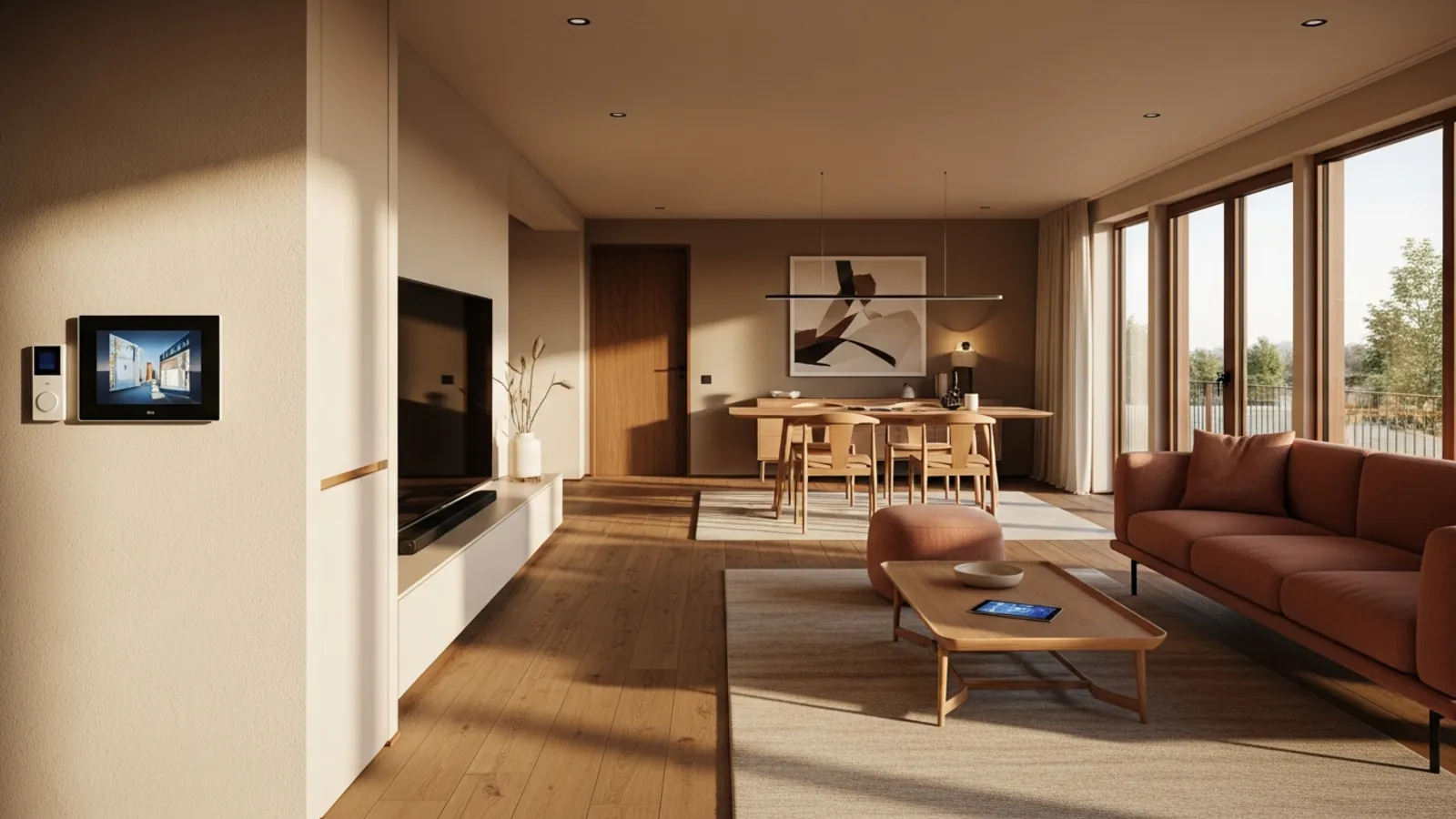
In 2026, smart home in prefabricated houses will no longer be a gimmick, but rather essential control system: heat pump, PV, storage, shading, Lighting and security technology are provided via a bus or radio system orchestrated.The central question is not whether, but which system – KNX, Loxone or Matter? This guide compares the five relevant ones systems and presents three realistic equipment packages from 8,000 to 35,000 euros.
Why Smart Home in a new building – and not just afterwards?
In brief: Anyone who forgoes a smart home in a new building is building a future one Additional costs: Subsequent cabling in a finished prefabricated house In 2026 it will cost two to four times as much as prepared in the factory. At Wired systems (KNX, Loxone) are factory preparedessential - the bus cables must already be in the factory prefabrication Wall elements are laid. Radio systems (Matter, Zigbee) can be used retrofit, but are slower, less reliable and more power intensive.
There are three reasons for factory preparation in 2026: Firstly, it saves money Installation in the factory 60-75 percent of the installation costs. Second, become Bus lines and sensor points neatly integrated into the mural (no surface-mounted). Third, the hydraulic connection is heat pump ↔PV system ↔ Wallbox only economical with high-quality control logic can be exhausted - the system determines when the electric car is charged, the memory filled or the domestic water is heated.
KNX, Loxone, Matter, Apple Home, Home Assistant – the five systems in comparison
In brief: In 2026, five smart home platforms will dominate the prefabricated house market: KNX (open industry standard), Loxone (proprietary, highly integrated), Matter (new wireless standard, Apple/Google/Amazon), Apple Home (tablets/iPhones), Home Assistant (open source, hobbyist).KNX and Loxone are wired, Professional solutions with a long service life. Matter and Apple Home are radio-based and consumer-friendly. Home Assistant connects everything, is but more maintenance intensive.
Smart home systems 2026 in direct comparison
| system | type | Investment EFH | life | Professional suitability |
|---|---|---|---|---|
| KNX | Bus, wired | 12.000–28.000 € | 20+ years | very high |
| Loxone | Bus, wired | 9.000–22.000 € | 15+ years | high |
| Matter (via Hub) | Radio, IP-based | 1.500–6.500 € | 8-12 years | medium |
| Apple Home | Funk, Apple only | 1.000–4.500 € | 8-10 years | low |
| Home assistant | Radio + Bus, OpenSource | 800–4.000 € | highly dependent on maintenance. | hobbyist |
KNX is the industry standard with over 9,000 certified worldwide Devices from 500+ manufacturers. Advantages: secure investment, cross-manufacturer, available for a long time. Disadvantages: higher initial costs, Mandatory factory cabling, ETS software required for commissioning(license costs). Loxone is cheaper and easier to program, but is tied to one manufacturer. Matter is the hope of Consumer market – wireless, cross-platform, but still has 2026 Implementation weaknesses in heating and shading.
Which system for whom?
If you think long-term, value investment security and want a professional system → KNX. If you are cost conscious, one Providers want and value simple programming → Loxone. IfYou want to retrofit an existing prefabricated house or just get started → Matter via Apple Home or Home Assistant.
Three equipment packages: Basic, Comfort, Premium
In brief: Three realistic packages will cover 90 percent of EFH needs in 2026: Basic €8,000 with heating control per room, shading and light switches by bus. Comfort €18,000 expanded to include multiroom audio, security (window/door sensors), weather station and energy management.Premium 35,000 € integrated KNX visualization with touch panels, smart Exterior lighting, door intercom with facial recognition, pool control and complete PV wallbox heat pump optimization.
Smart home packages EFH 140 m² (2026)
| function | Base 8k € | Comfort 18k € | Premium 35k € |
|---|---|---|---|
| Individual room control heating | ✓ | ✓ | ✓ |
| Shading (Venetian blind/roller blind) | ✓ (8 points) | ✓ (12 points) | ✓ (16 points) |
| Bus light switch, dimmable | ✓ (16 pts) | ✓ (28 pts) | ✓ (45 pts) |
| Weather station with slat control | — | ✓ | ✓ |
| Multiroom audio (Sonos / Loxone) | — | ✓ (3 zones) | ✓ (6 zones) |
| Door/window contacts | — | ✓ (10 points) | ✓ (16 points) |
| Motion sensors outside | — | ✓ | ✓ |
| Visualization touch panels | Smartphone app | 1× Tablet 7" | 3× KNX touch display |
| Door intercom with video | Bell button | Intercom video | + Face recognition |
| Energy management (PV/WP/Wallbox) | — | ✓ easy | ✓ Load optimization |
| Pool/sauna control | — | — | ✓ |
Which package is right for you depends on the living space, number of rooms and lifestyle. Families with children benefit disproportionately Comfort functions such as shading (visibility and sun protection), while Dual-earner households without children often get the basic package plus Energy management is well advised.
Request three providers with KNX or Loxone experience
Not every brand provider has a professional smart home program. We will refer you to three providers from our 35-manufacturer detailed comparison who integrate KNX or Loxone as standard in factory planning.
Energy management: The most important smart home use case in 2026
In brief: Energy management will be the most economically relevant use case in 2026 of the smart home. It orchestrates PV generation, storage charging/discharging Strategy, heat pump operation (especially domestic hot water) and wallbox Charge. When optimally set, it increases self-consumption by 15-25percentage points and reduces heating energy by 8-18 percent. At one For a typical 10 kWp PV system, this corresponds to around 600-900 euros annually Electricity cost savings.
Energy manager platforms 2026: SMA Sunny Home Manager, E3/DC S10E Home power plant, sonnen Eco, Loxone Energy Manager. Everyone commits to KfW Compliant heat pumps, wall boxes and storage as so-called EEBus devices. For brand providers with a complete energy package (e.g.Hanse Haus “Energy+”, Schwabenhaus “Energy Edition”) is the Integration available ex works. More about heat pump integration in Heat pump guide, for PV design in PV Guide.
Security: alarm system, video surveillance, access control
In brief: Security features will be the second most common smart home argument in 2026 according to energy management. An integrated system typically includes: Door/window contacts, inside motion sensors, outside cameras Person recognition, door intercom with video, smart door lockDrive (code, key app, fingerprint), glass break sensors, optional Smoke and water detectors. Investment €4,000-14,000 depending on Depth of functions and number of external cameras.
- Door/window sensors (bus or radio) with activation via presence mode.
- Outdoor cameras with person detection (Reolink, Hikvision, Loxone) – operate in compliance with GDPR.
- Door intercom with video function (Doorbird, Loxone Intercom, Comelit).
- Smart door cylinder or motor lock (Nuki, Yale, KIWI, Burg-Wächter).
- Glass breakage sensors in ground floor rooms (passive, low battery).
- Networked smoke detectors with central visualization (MANDATORY in all federal states, smart version optional).
- Water detector in HWR / bathroom / under dishwasher - protects against hidden damage.
GDPR for outdoor cameras
Outdoor cameras in Germany will ONLY be allowed to be your own in 2026 Record property area. Sidewalks, neighboring properties and Public paths must be hidden from the viewing angle. Violations can trigger fines and compensation according to Section 823 of the German Civil Code (BGB).justify. Software-side masking (“Privacy Zones”) is therefore Duty. A “video surveillance” sign should be clearly visible be installed.
Retrofitting: What can be done in existing buildings and what can only be done in new buildings?
In brief: A lot of things can be retrofitted in existing buildings in 2026 - but mostly on a radio basis and with compromises. Radio-based systems (Zigbee, Z-Wave, Matter, EnOcean, Homematic IP) can be retrofitted anywhere. KNX and Loxone are possible in existing buildings, but expensive (wall openings, fire protection).Who If you want to make a prefabricated house from the 90s smart, go with Matter + Apple Home / Google Home is often best. Investment typically 2,500-8,000 Euro, effort 1-4 weekends DIY or 2-4 days professional.
Modernizing an existing prefabricated house from the 80s/90s is a separate topic – detailed strategies in Modernization guide. Anyone who opens walls as part of energy-saving renovation should do so take advantage of the opportunity for KNX preparation – that’s it most economical form of retrofitting existing buildings.
Data protection, GDPR and cloud dependency
In brief: Data protection is central in 2026: KNX and Loxone work as standard locally without cloud, data does not leave your house. Apple Home and Matter Work in the home network without the cloud, optionally with iCloud sync. GoogleHome and Amazon Alexa use US cloud servers - this is GDPR-compliant controversial. Home Assistant is 100 percent local unless none Cloud integrations are enabled. Anyone who has sensitive data (cameras, If you want to keep presence) local, choose KNX, Loxone or Home Assistant.
When selecting devices for 2026, it is worth taking a look at the data protection regulations. Architecture: Does the manufacturer have a clear headquarters in the EU? Become Data processed locally or streamed to the USA? Is there one Open source alternative (Tasmota, ESPHome) to commercial firmware?High-quality KNX devices will be the most data protection-friendly solution in 2026, because they can be operated without the cloud.
Recommendation 2026: When which system?
In brief: Our recommendation for 2026: In new prefabricated houses with heat pumps and PV KNX as a wired bus is the most economical solution in the long term. Loxone is the price-conscious premium alternative. Matter is suitablefor existing buildings or builders who want to start simply and step by step want to expand. Important: Factory preparation of the bus cables Hire prefabricated house providers so that you have all the options for the next Keep open for 20 years.
Have the smart home prepared in the factory
Let three brand providers create fixed price offers for your dream smart home. We bundle your request to three providers with tried-and-tested KNX or Loxone programs - free of charge, without obligation.
Ready for the next step?
Use our network of reviewed providers to receive free quotes matched to your requirements.
Compare quotes nowFrequently asked questions
The most common questions about Smart homes in prefabricated construction 2026, answered concisely by the fertig-haus.net editorial team (updated 2026).
